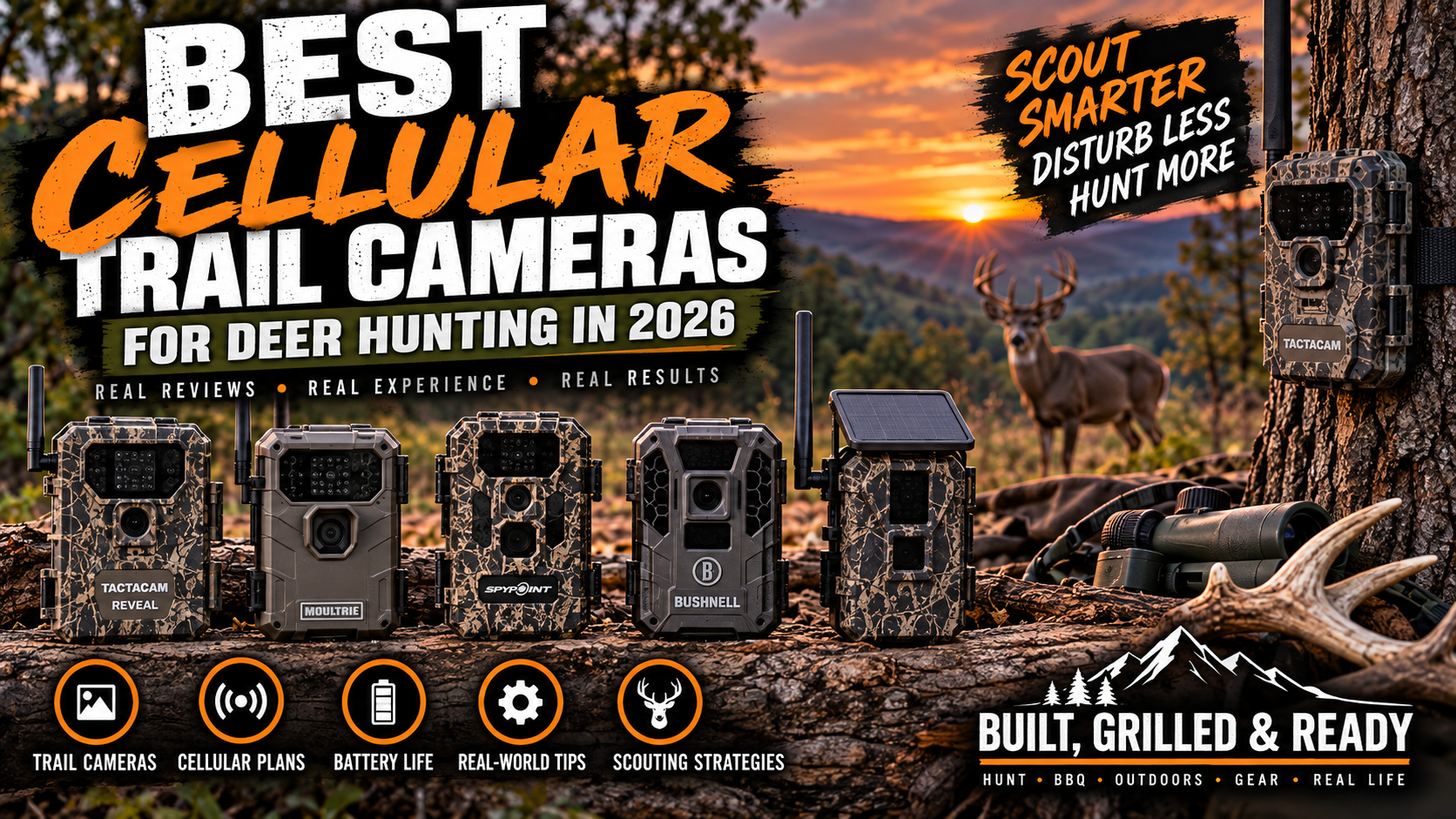
Cellular trail cameras have changed the way many hunters scout deer.
Instead of walking into an area every few weeks to pull an SD card, a cellular camera can send photos directly to your phone. That means you can monitor trails, feeders, food plots, scrapes and other high-traffic areas while reducing unnecessary trips into your hunting area.
But there’s a catch.
Buying the camera is only part of the decision.
You also need to consider cellular coverage, data-plan costs, battery life, nighttime performance, trigger speed, the quality of the mobile app and how many cameras you eventually plan to run.
I’ve personally experienced how useful cellular cameras can be. I currently own and use three Tactacam cellular trail cameras, and they’ve become a practical part of the way I monitor deer activity.
In this guide, we’ll look at several current cellular trail-camera options and, more importantly, explain what actually matters when choosing one.
Affiliate Disclosure: As an Amazon Associate I earn from qualifying purchases. This post contains affiliate links, which means I may earn a commission if you purchase through one of my links, at no additional cost to you.
Quick Picks
If you don’t want to read the entire guide, these are the cameras I’d look at first:
Tactacam REVEAL X 4.0 — Strong option for hunters who want the current-generation REVEAL platform without moving to the more expensive Pro model.
Tactacam REVEAL Pro 4.0 — Adds higher-end features for hunters who want more capability from the REVEAL ecosystem.
Tactacam REVEAL X 3.0 — Older-generation REVEAL that can still make sense when the price is right.
Moultrie EDGE 3 Pro — Worth considering if you want Moultrie’s app ecosystem and automatic carrier selection.
SPYPOINT FLEX Series — Offers several price points and one particularly attractive feature: a free 100-photo-per-month plan on many cellular models.
We’ll break down the differences below.

1. Tactacam REVEAL X 4.0
A Strong Starting Point in the Current REVEAL Lineup
The REVEAL X 4.0 is one of Tactacam’s current-generation cellular cameras.
Tactacam currently lists the X 4.0 at $129.99 and advertises 4K imagery, 1080p video, built-in GPS and cellular connectivity through its REVEAL system. It also works with Tactacam’s new FlexPack rechargeable power system.
That last feature deserves more attention than it might initially get.
Cellular cameras can spend months in the field. The less frequently you need to walk in and replace batteries, the better.
Why I’d consider it
The X 4.0 sits in a useful position for someone who wants a current REVEAL camera without paying for every feature available on the Pro.
It’s also a logical choice if you think you may eventually add additional REVEAL cameras because you’re building everything around one app and ecosystem.

2. Tactacam REVEAL Pro 4.0
The Higher-End REVEAL Option
If you want more capability, move up to the REVEAL Pro 4.0.
Tactacam currently lists it at $159.99. The current REVEAL lineup includes features such as GPS, 4K imagery and 1080p video, while the Pro model adds higher-end capabilities within the platform.
The Pro series is especially interesting if you want to take advantage of features beyond simply receiving triggered photos.
Tactacam’s Live View system, for example, can provide real-time video through the REVEAL app on compatible cameras. Tactacam says Live View requires a qualifying plan/add-on and sufficient LTE signal, so don’t assume every feature is included with the basic camera subscription.
Our Real-World Experience With Tactacam REVEAL
This is one brand on this list that isn’t here simply because its specifications look good on paper.
I personally own and use three Tactacam cellular trail cameras.
And they’ve been very useful.
The biggest advantage for me is straightforward: I don’t have to physically visit the camera every time I want to know what’s happening.
With a traditional SD-card camera, checking activity means walking or driving to the camera, opening it and retrieving the card.
With a cellular camera, pictures come to your phone.
That makes it much easier to monitor deer activity while reducing unnecessary trips into the area you’re hunting.
If you’re trying to determine when deer are using a feeder, trail or another location, being able to check activity remotely is extremely convenient.
It also becomes more valuable as you add cameras.
One cellular camera gives you information from one location.
With three cameras positioned around a property, you can begin comparing activity between locations without constantly traveling from camera to camera.
What I’ve learned from actually using them
Cellular cameras aren’t magic.
Their usefulness still depends on:
Cellular signal.
A camera can’t reliably transmit images without a usable connection.
Camera placement.
A $150 camera pointed at the wrong location isn’t going to tell you much.
Battery management.
More transmissions and more advanced features generally mean more demand on your power source.
Settings.
You need to balance image frequency, sensitivity and transmission behavior against battery consumption and the number of unnecessary pictures you receive.
But after using three Tactacams myself, I can say the fundamental concept works extremely well for the way I hunt.
That’s why Tactacam earns a prominent place in this guide.

3. Tactacam REVEAL X 3.0
A Previous-Generation Option That Still Makes Sense
Don’t automatically ignore the previous generation just because a 4.0 exists.
Tactacam still lists the REVEAL X 3.0 at $99.99, which puts it below the current X 4.0.
If your primary objective is receiving trail-camera photos remotely, an older camera at a good price can sometimes make more financial sense than buying the newest model.
This becomes especially important when you’re buying several cameras.
Saving $20–$30 per camera doesn’t sound enormous until you’re deploying four, six or eight of them.
The better question isn’t:
What’s the newest trail camera?
It’s:
What features will I actually use?
If the X 3.0 does everything your hunting setup requires, spending more simply to own the newest version may not accomplish much.

4. Moultrie EDGE 3 Pro
Moultrie is another major player worth considering.
One particularly useful feature of the EDGE 3 Pro platform is automatic carrier selection.
Moultrie says the camera can select among major cellular networks rather than requiring you to match the camera to your personal phone carrier. The company also specifically notes that cellular-camera coverage can differ from your phone’s coverage in rural areas.
That’s an important distinction.
Your phone carrier doesn’t determine your trail-camera carrier.
A Verizon phone does not necessarily mean you need a Verizon-specific trail camera.
What matters is which network provides usable service where the camera is actually mounted.
Moultrie’s current plans also deserve consideration if you’re planning a large deployment. Its Standard plan is currently $9.99 per month per camera, while its Pro Series structure is designed for larger multi-camera setups.

5. SPYPOINT FLEX-M2
An Interesting Budget-Friendly Ecosystem
SPYPOINT deserves consideration for hunters who want to keep recurring costs under control.
The current FLEX-M2 uses multi-network connectivity and is rated by SPYPOINT for 32MP photos, 1080p video, a 0.4-second trigger speed and approximately 90-foot detection and flash ranges.
But the feature that may matter most to budget-conscious hunters isn’t camera resolution.
It’s the data plan.
SPYPOINT currently provides 100 free photo transmissions per month per camera on eligible cellular cameras. Paid plans are available when you need more.
For someone experimenting with cellular cameras or maintaining a camera in a relatively low-traffic location, that can be attractive.

6. SPYPOINT FLEX-DARK
If nighttime discretion matters, look at the FLEX-DARK.
SPYPOINT lists the current model with 40MP photo resolution, 1080p video, a 0.3-second trigger speed and approximately 100-foot detection and flash ranges. It also provides selectable low-glow/no-glow capability.
No-glow infrared is useful when you want to minimize visible illumination at night.
There is usually a tradeoff somewhere in trail-camera design, however, so don’t select a camera based solely on the largest megapixel number printed on the package.
More on that below.

7. Bushnell CelluCORE Live
Bushnell’s CelluCORE Live is another option for hunters particularly interested in real-time viewing.
Bushnell currently advertises 32MP images, dual-SIM connectivity, no-glow infrared, approximately 100 feet of night range and live video sessions accessible through a smartphone.
Live video sounds great—and it can be useful—but consider the practical tradeoffs.
Streaming requires a good cellular connection and consumes considerably more power and data than simply transmitting occasional photographs.
For a camera mounted in a remote location for months, reliable photo transmission and battery life may matter more than watching live video.
Cellular Trail Camera Comparison
| Camera | Why Consider It |
|---|---|
| Tactacam REVEAL X 4.0 | Current-generation REVEAL with strong core features |
| Tactacam REVEAL Pro 4.0 | Higher-end REVEAL features |
| Tactacam REVEAL X 3.0 | Lower-cost entry into REVEAL |
| Moultrie EDGE 3 Pro | Strong multi-carrier/app ecosystem |
| SPYPOINT FLEX-M2 | Value-oriented option with free-photo plan |
| SPYPOINT FLEX-DARK | No-glow-focused option |
| Bushnell CelluCORE Live | Live-view capability |
Don’t make the decision from this table alone.
There are several things that matter more than the name on the camera.
Cellular Coverage Comes First
You can buy the most expensive cellular trail camera available and still be disappointed if it can’t connect where you hunt.
Check coverage where the CAMERA will be.
Not:
- At your house
- At the hunting camp
- At the highway
- In the nearest town
You care about the signal at the tree where you’re mounting the camera.
Modern multi-carrier cameras make this easier because the camera can select among supported networks.
But they still require cellular service.
If the property has little or no usable cellular coverage, a conventional SD-card camera may still be the better tool.
Don’t Get Distracted by Megapixels
Trail-camera marketing loves megapixels.
24MP.
32MP.
40MP.
4K.
Those numbers look impressive on packaging, but they don’t tell the whole story.
Sensor quality, optics, image processing, lighting and compression all affect the final image.
More megapixels don’t automatically mean you’ll receive a dramatically better picture on your phone.
For deer scouting, ask a more practical question:
Can I clearly identify what I need to see?
You usually care about:
- Whether the animal is a buck or doe
- Antler characteristics
- Approximate age/size
- Direction of travel
- Time
- Date
- Repeated patterns
If the camera reliably provides that information, it’s doing its job.
Trigger Speed Matters—but Placement Matters More
Trigger speed is important because you don’t want every picture to contain the back half of a deer leaving the frame.
But camera placement can solve a lot of problems.
Whenever possible, avoid positioning the camera so deer are expected to cross the detection zone at a hard 90-degree angle only a few feet away.
Give the camera time to detect the animal and capture useful images.
Positioning the camera so deer approach or travel diagonally through the detection zone can often produce better results.
Low Glow vs. No Glow
You’ll see both terms frequently.
Low-glow infrared
The LEDs can produce a faint red glow when activated.
Potential advantages include strong nighttime illumination and good range.
No-glow infrared
Designed to minimize visible illumination.
This can be useful when discretion is especially important.
Neither automatically makes a camera better.
For a private property where camera visibility isn’t much of a concern, low glow may be perfectly acceptable.
For a location where you want maximum discretion, no glow becomes more attractive.
Cellular Trail Camera Plans: Don’t Ignore the Monthly Cost
This is one of the biggest mistakes people make.
They compare:
$99 camera vs. $129 camera.
But that’s only the initial cost.
Cellular cameras generally require an active service plan to transmit photos.
And if you’re running multiple cameras, subscription costs can eventually exceed what you paid for the hardware.
Tactacam currently advertises REVEAL plans starting at $5 per month and provides discounted pricing for additional cameras on its plans.
SPYPOINT currently offers 100 free photos per month per camera, with paid plans for higher usage.
Moultrie’s current Standard plan is $9.99/month per camera, with other options including an unlimited individual-camera plan and a Pro Series structure aimed at larger deployments.
Calculate the annual cost before buying several cameras.
A cheap camera with an expensive plan can ultimately cost more than a more expensive camera with a plan that better matches your usage.
Multiple Cameras Change the Equation
This is something I’ve experienced firsthand because I run three Tactacam cameras.
Once you move from one camera to several, your priorities change.
You’re no longer just shopping for a trail camera.
You’re choosing an ecosystem.
Now you care about:
- Cost per additional camera
- One app controlling everything
- Battery strategy
- Image organization
- Mapping
- Camera naming
- Notifications
- Subscription costs
- Accessories that work across your cameras
If you think you’ll eventually own several cellular cameras, look at the entire platform before buying the first one.
That’s one reason I’ve found my three-camera Tactacam setup so useful: I can monitor multiple locations through the same system instead of treating each camera as an isolated device.
Battery Life Matters More Than You Think
A cellular camera uses power not only to capture a photograph but also to transmit information.
Heavy activity can therefore consume batteries faster.
Things that can affect battery consumption include:
- Number of triggers
- Number of transmissions
- Video use
- Live viewing
- Temperature
- Cellular signal strength
- Camera settings
Weak cellular signal can be especially problematic because the device may need to work harder to maintain connectivity.
Consider Rechargeable Batteries and Solar
If you plan to leave cameras deployed for long periods, external power deserves serious consideration.
Tactacam’s current 4.0 cameras support its FlexPack rechargeable battery system, and the company also offers an R5 solar panel with a built-in 5,000mAh battery.
Solar won’t work equally well everywhere.
A camera buried under a dense canopy may not receive enough sunlight.
But on a field edge, feeder location or another reasonably open area, solar can reduce the number of trips required to service the camera.
And fewer trips into the area can be valuable during hunting season.
Where Should You Put a Cellular Trail Camera?
The technology doesn’t matter much if the camera is watching an empty patch of woods.
Start with locations where deer movement is naturally concentrated.
Good candidates include:
Trails
Especially intersections and heavily used travel corridors.
Funnels
Terrain or vegetation that concentrates movement.
Scrapes
Extremely useful during the pre-rut and rut.
Food plots
Good for monitoring entry points and timing.
Feeders
Where lawful, they can provide consistent opportunities to monitor activity.
Water
Especially in hot or dry conditions.
Field edges
Useful for determining where deer enter and exit.
Always follow applicable hunting, baiting, trail-camera and public-land regulations for your location.
Don’t Check a Cellular Camera Like a Regular Trail Camera
One of the main reasons to own a cellular camera is so you don’t have to visit it constantly.
If pictures are transmitting correctly and the battery level looks good, leave it alone.
That’s the point.
Every unnecessary trip can create:
- Noise
- Human scent
- Disturbance
- Additional pressure
Let the camera do its job.
How I Would Build a Three-Camera Setup
Since three cameras is what I personally run, here’s a simple way to think about coverage.
Camera 1 — Primary food source or feeder
This gives you a baseline for which deer are regularly using the property.
Camera 2 — Travel corridor
Put another camera on a major trail or funnel leading toward or away from the primary feeding area.
Camera 3 — Secondary location
Use the third camera somewhere that answers a specific question.
That could be:
- A scrape
- Bedding-area transition
- Creek crossing
- Secondary feeder
- Field entrance
- Different section of the property
Now you’re doing more than collecting deer pictures.
You’re gathering information about movement.
If the same buck appears at Camera 1 and then Camera 2 repeatedly, the timestamps can begin telling you how he’s using the property.
That’s where multiple cellular cameras become particularly useful.
Should You Buy One Expensive Camera or Several Cheaper Cameras?
For scouting specifically, coverage has enormous value.
I’d rather think in terms of:
Information per dollar.
One premium camera provides excellent information about one location.
Several reliable midrange cameras may provide useful information about several locations.
That doesn’t mean cheaper is always better.
It means you should decide whether premium features or broader property coverage will help you more.
What I Would Buy First
For someone entering cellular trail cameras today, I would start by comparing three things:
Tactacam REVEAL X 4.0 if you’re interested in the REVEAL ecosystem and want a current-generation model.
Moultrie EDGE 3 Pro if Moultrie’s app, mapping and multi-camera plan structure fit your needs.
SPYPOINT FLEX-M2 if controlling the initial and recurring cost is particularly important.
Then compare actual cellular coverage and subscription costs for the number of cameras you intend to operate.
Are Cellular Trail Cameras Worth It?
For the way I use trail cameras, yes—they’ve been extremely useful.
Owning three Tactacams allows me to monitor multiple locations without physically checking an SD card every time I want information.
That’s the real advantage.
A cellular camera doesn’t make deer appear.
It doesn’t replace scouting.
And it doesn’t tell you exactly where to hunt.
What it does is give you more information with fewer trips into the woods.
Used correctly, that’s a valuable tool.
Frequently Asked Questions
Do cellular trail cameras need Wi-Fi?
No.
They transmit through supported cellular networks. Wi-Fi or Bluetooth may be used for certain local setup functions depending on the camera, but normal remote image transmission relies on cellular service.
Does my trail camera have to use the same carrier as my phone?
No.
Your phone carrier and trail-camera service are separate. Multi-carrier cameras can select among supported networks based on available coverage.
Do cellular trail cameras work without a subscription?
The camera may still have some local functionality depending on the model, but cellular image transmission generally requires an applicable service plan. SPYPOINT is notable for currently offering a limited free-photo plan on eligible cameras.
Do cellular trail cameras work where there’s no cell service?
Not for normal cellular transmission.
If there isn’t usable cellular service, you’ll generally need to retrieve images locally or use a different technology. SPYPOINT has announced its FLEX-RANGE with optional backup satellite connectivity for 2026, but availability and service details should be verified before purchasing specifically for that capability.
How many cellular trail cameras do I need?
There’s no universal number.
One camera can monitor a specific high-value location. Multiple cameras become useful when you’re trying to understand how deer move between several locations.
I personally use three, which provides considerably more information than relying on a single location.
Build Your Deer Hunting Setup
A cellular trail camera is only one part of a practical hunting setup.
If you’re preparing for deer season, also see:
15 Essential Deer Hunting Gear Items You’ll Actually Use
and
What to Pack in Your Deer Hunting Backpack: Complete Checklist
Those guides cover the other equipment worth considering before heading into the woods.
Final Thoughts
The best cellular trail camera isn’t necessarily the one with the biggest megapixel number, longest feature list or highest price.
Look at the complete system:
Coverage. App. Battery life. Image quality. Subscription cost. Reliability.
And if you’re planning to run several cameras, pay particular attention to the cost and convenience of managing the entire fleet.
My own experience running three Tactacam cellular cameras has shown me how useful this technology can be. Being able to monitor several locations remotely provides information without requiring constant trips to pull SD cards.
Start with one or two well-placed cameras.
Learn what the information is telling you.
Then expand your setup where additional cameras will actually answer a scouting question.
Built. Grilled. Ready.
Scout smarter. Disturb less. Hunt prepared.
Leave a Reply