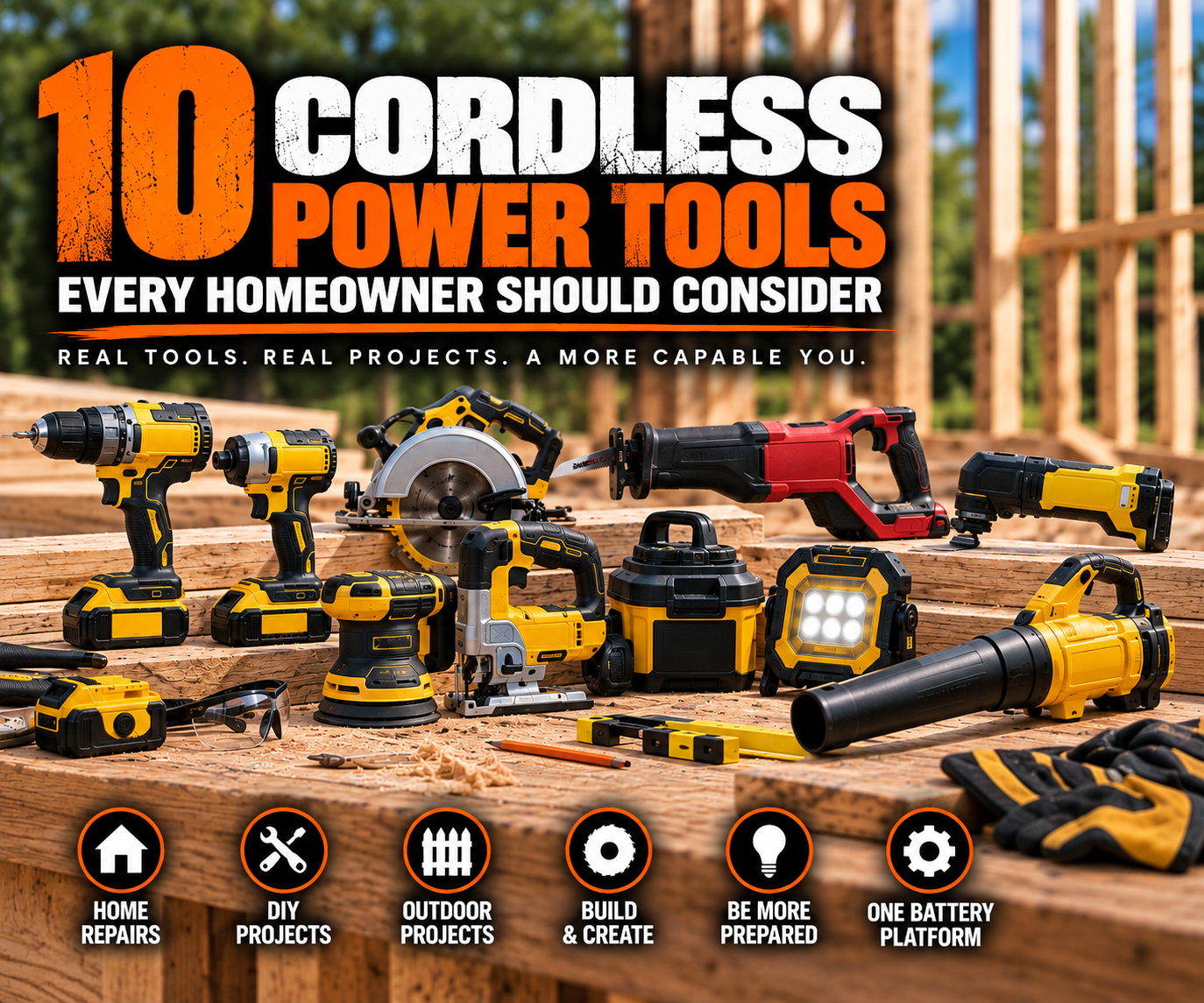
You don’t need a professional workshop full of power tools to take care of your home.
For most homeowners, a relatively small collection of cordless tools can handle everything from hanging shelves and assembling furniture to building a fence, repairing a deck or tackling weekend DIY projects.
The key is buying tools you’ll actually use—and choosing a cordless battery platform that makes sense before your collection starts growing.
Here are 10 cordless power tools worth considering as you build your DIY setup.
Affiliate Disclosure: As an Amazon Associate I earn from qualifying purchases. This post contains affiliate links, which means I may earn a commission if you purchase through one of my links, at no additional cost to you.
Before You Buy: Choose a Battery Platform
This is one of the most important decisions you’ll make when buying cordless power tools.
Cordless tools generally use proprietary battery systems. Once you own several batteries and chargers from one manufacturer, buying additional compatible tools from that same platform can be considerably more convenient.
Instead of buying a completely different battery and charger every time you need another tool, you can often purchase a bare tool that works with batteries you already own.
Popular cordless platforms include DEWALT 20V MAX, Milwaukee M18, RYOBI ONE+, Makita LXT and several others.
There isn’t one platform that’s right for everyone. Think about the tools you’re likely to buy over the next several years, availability near you and your budget.
If you’re starting from scratch, your first drill or impact-driver kit can be the beginning of your entire cordless tool collection.

1. Cordless Drill/Driver
If you’re buying only one cordless power tool, start here.
A drill/driver handles an enormous variety of homeowner tasks. You can drill holes, drive screws, assemble furniture, install hardware, hang shelves and tackle countless repairs around the house.
For a first drill, buying a kit that includes at least one battery and charger usually makes more sense than buying the bare tool.
Useful for:
- Drilling holes
- Driving screws
- Installing shelves
- Furniture assembly
- Basic repairs
- General DIY projects
Built, Grilled & Ready Tip: Don’t buy the biggest drill simply because it has the most impressive specifications. A compact drill that’s comfortable to use can be more useful for everyday homeowner projects.
2. Impact Driver
A drill and an impact driver may look similar, but they’re designed for different jobs.
An impact driver delivers rotational impacts that make driving long screws and larger fasteners much easier.
If you’re building decks, fences, sheds, workbenches or other projects that involve a lot of screws, an impact driver can quickly become one of your most-used tools.
Useful for:
- Long construction screws
- Deck projects
- Fence repairs
- Structural fasteners
- Building workbenches
- Outdoor projects
Drill vs. Impact Driver
For general drilling and lighter screw-driving, use the drill.
When you’re driving longer screws or heavier fasteners, reach for the impact driver.
Eventually, having both is extremely useful.
3. Cordless Circular Saw
Once you start building projects from lumber or sheet goods, a circular saw becomes extremely useful.
A cordless circular saw can make quick straight cuts without requiring an extension cord or permanent workshop.
With a straightedge or guide, you can make surprisingly accurate cuts for many homeowner projects.
Useful for:
- Cutting lumber
- Deck repairs
- Fence projects
- Shelving
- Plywood
- Outdoor builds
Always use appropriate eye protection and follow the manufacturer’s operating and safety instructions.

4. Cordless Reciprocating Saw
The reciprocating saw is the demolition and rough-cutting tool of the group.
Rather than producing perfectly finished cuts, it’s designed to cut through material quickly.
With the appropriate blade, a reciprocating saw can handle wood, PVC, certain metals and other materials.
It’s especially useful when you’re tearing something apart rather than building something that needs a finished edge.
Useful for:
- Demolition
- Cutting damaged lumber
- Removing old structures
- PVC pipe
- Pruning
- Remodeling projects
The blade matters almost as much as the saw. Make sure you’re using a blade designed for the material you’re cutting.
5. Oscillating Multi-Tool
This may be one of the most underrated tools a homeowner can own.
An oscillating multi-tool uses interchangeable accessories to cut, scrape, sand and perform detailed work in places where larger power tools can’t reach.
Need to make a small plunge cut in drywall? Trim a door jamb? Remove grout? Cut something flush against a surface?
This is often the tool you’ll reach for.
Useful for:
- Drywall repairs
- Door jambs
- Flush cuts
- Removing grout
- Scraping adhesive
- Small remodeling projects
It’s one of those tools you may not think you need until a project suddenly makes it invaluable.
6. Orbital Sander
If you’re refinishing furniture, building shelves or doing woodworking projects, sanding by hand gets old quickly.
A cordless orbital sander can make surface preparation much faster while producing a more consistent finish.
Useful for:
- Furniture projects
- Woodworking
- Removing old finishes
- Preparing wood for paint
- Preparing wood for stain
- Smoothing project lumber
Keep several sandpaper grits available so you can move from material removal to final surface preparation.

7. Cordless Jigsaw
A circular saw is excellent for straight cuts.
A jigsaw is much better when you need curves, cutouts or more detailed shapes.
It’s particularly useful for smaller woodworking projects and situations where a circular saw simply can’t make the cut you need.
Useful for:
- Curved cuts
- Countertop cutouts
- Small woodworking projects
- Plywood
- Shelving
- Detailed cuts
Like a reciprocating saw, blade selection matters. Different blades are designed for different materials and types of cuts.
8. Cordless Shop Vacuum
This isn’t the most exciting tool on the list, but you’ll probably use it constantly.
A compact cordless shop vacuum is excellent for cleaning up sawdust, screws, dirt and small messes during projects.
It’s especially convenient because you don’t have to drag out an extension cord every time you drill a few holes or make a couple of cuts.
Useful for:
- Sawdust
- Garage cleanup
- Vehicle cleanup
- Small project messes
- Workshop cleanup
- Home repairs
If you’re already invested in a cordless battery platform, a compatible shop vacuum can be a very convenient addition.
9. Cordless Work Light
Good lighting makes almost every project easier.
A cordless work light is useful in attics, underneath sinks, inside cabinets, during power outages or anywhere your normal lighting doesn’t reach.
Some models can stand on their own, hang from objects or rotate to illuminate a specific work area.
Useful for:
- Plumbing repairs
- Attics
- Garages
- Under-sink work
- Power outages
- Outdoor projects after dark
This is another tool that makes a lot of sense as a bare-tool purchase once you already own compatible batteries.
10. Cordless Blower
A cordless blower isn’t just for leaves.
For homeowners who regularly work in the garage, driveway, patio or yard, a compact blower can become surprisingly useful.
Use it to clear sawdust from a workspace, clean the garage floor or quickly clear debris from sidewalks and patios.
Useful for:
- Garage cleanup
- Driveways
- Patios
- Grass clippings
- Leaves
- Workshop cleanup
If your cordless platform also includes outdoor power equipment, a blower can be another reason to stay within the same battery ecosystem.
Which Cordless Power Tools Should You Buy First?
You don’t need all 10 immediately.
If you’re building your tool collection from scratch, I’d start with:
1. Cordless Drill/Driver
The most versatile power tool for basic homeowner projects.
2. Impact Driver
Extremely useful once you start building with longer screws and structural fasteners.
3. Circular Saw
Opens the door to larger woodworking and construction projects.
4. Oscillating Multi-Tool
Excellent for repairs, remodeling and awkward cuts.
5. Work Light
Simple, relatively inexpensive and useful for far more projects than you might expect.
After that, let your projects determine what you buy next.
If you’re refinishing furniture, buy the sander.
If you’re doing demolition, buy the reciprocating saw.
If you’re making curved cuts, buy the jigsaw.
There’s little reason to spend hundreds of dollars on tools that sit unused.
Kit vs. Bare Tool: Know the Difference
When shopping for cordless tools, pay attention to whether you’re buying a kit or a bare tool.
A kit typically includes:
- Tool
- Battery
- Charger
A bare tool generally includes only the tool.
Your first purchase within a battery platform will usually need to be a kit unless you already have compatible batteries and a charger.
Once you have several batteries, bare tools can become a cost-effective way to expand your collection.
Don’t Ignore Battery Size
Higher-capacity batteries generally provide longer runtime, but they also add weight.
A large battery can make sense on a circular saw or blower, while a smaller battery may make a drill or impact driver considerably easier to handle.
You don’t necessarily need the largest battery available on every tool.
Match the battery to the job.
Don’t Buy Tools Just to Own Tools
It’s easy to get carried away once you start building a cordless tool collection.
But a good DIY setup isn’t measured by how many tools are hanging on the wall.
It’s measured by whether you have the right tool when something needs to be fixed, built or improved.
Start with the basics.
Use them.
Learn what they can do.
Then add tools when your projects give you a reason to buy them.
Already Building Your Homeowner Toolbox?
If you’re still putting together the basic hand tools every homeowner should have, check out our guide:
15 Essential DIY Tools Every Homeowner Should Own
It covers the hand tools, measuring equipment, safety gear and other basics that pair perfectly with the cordless tools in this guide.
Built. Grilled. Ready.
Practical tools. Real projects. A more capable homeowner.
Leave a Reply